
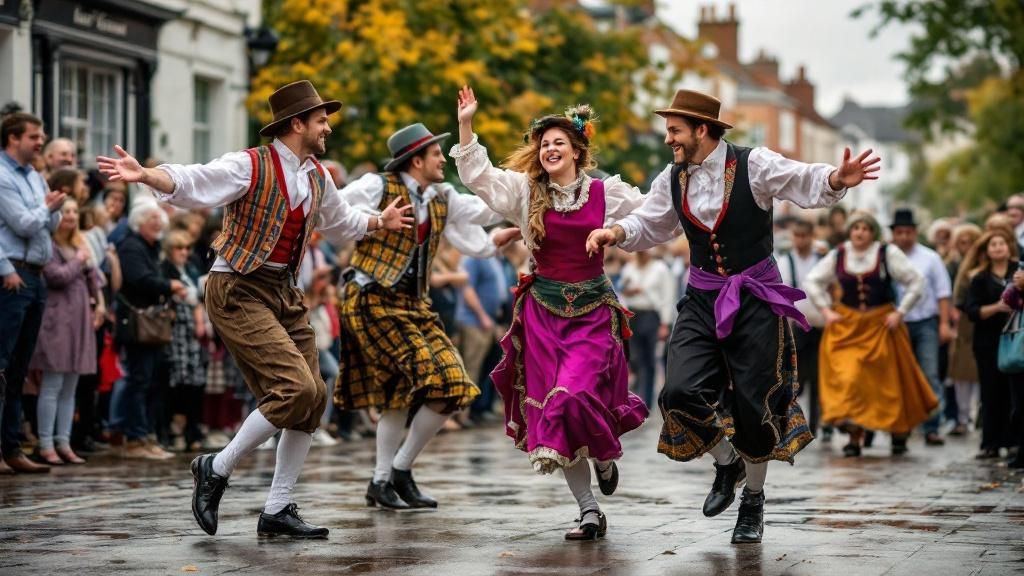
Once dismissed as a charming remnant of England’s pastoral past, Morris dancing is witnessing an surprising resurgence amongst Britain’s youth. From university societies to country spaces, enthusiasts aged under thirty are rediscovering the intricate steps, tinkling bell accoutrements, and colourful costumes that have characterised this centuries-old tradition. This article explores the forces propelling this heritage revival, examines how today’s practitioners are reworking the tradition, and considers what this fresh enthusiasm reveals about modern British perspectives towards cultural legacy and collective identity.
The Cultural Renaissance of Morris Dance
The revival of Morris dancing amongst younger British communities represents a striking move from years of falling participation. What was once viewed as an strictly countryside or aged pursuit has transformed into a dynamic cultural phenomenon, with university groups, metropolitan dance collectives, and local organisations enthusiastically adopting the tradition. This resurgence questions established stereotypes and proves that modern youth genuinely appreciate preserving and celebrating Britain’s folkloric heritage, reinvigorating practices that looked set for obscurity.
This revived interest transcends mere nostalgic curiosity; young performers are deliberately transforming Morris dancing for the modern era. They incorporate contemporary music, try out creative movement patterns, and establish inclusive communities that welcome participants irrespective of social background or dance experience. The shift demonstrates a wider cultural change wherein young British people actively pursue authentic connections to their heritage whilst simultaneously redefining the meaning of tradition, fostering a living conversation between cultural accuracy and present-day creative forms that speaks to what matters to their age group.
Why Younger Generations Are Embracing This Time-Honoured Craft
Morris dancing’s draw among younger generations transcends nostalgic curiosity. Contemporary dancers value the art form’s deep cultural roots whilst acknowledging its ability to enable creative expression and social connection. The openness of modern Morris groups, paired with their inclusive ethos, has shifted the perception of this traditionally insular pursuit. Young people are finding that Morris dancing provides a meaningful alternative to traditional pastimes, providing both bodily exertion and authentic social connection in an progressively computerised world.
Community Connection
In an period characterised by community breakdown, Morris dancing groups provide young people with tangible communities built upon shared values and collaborative practice. The welcoming character of modern Morris groups actively welcomes newcomers irrespective of background or experience, fostering genuine friendships and social bonds. Participants frequently characterise their dancing cohorts as chosen families, providing emotional support and belonging that extends well beyond the performance season. This communal feeling becomes especially important for young adults navigating the shift from education to work.
The collaborative framework of Morris dancing inherently fosters group unity and mutual responsibility. Each dancer’s contribution directly influences the group’s synchronized appearance and rhythmic precision, creating interdependence that strengthens community ties. Many young dancers note that their Morris groups enable real friendships in ways that traditional social environments regularly fail to accomplish. The joint investment to sustaining and advancing this cultural tradition creates a strong feeling of shared mission amongst members.
Physical Activity and Overall Wellbeing
Morris dancing demands considerable physical exertion, blending cardiovascular exercise with complex coordination and strength development. Young dancers gain improved fitness levels whilst participating in activity that carries cultural significance rather than merely utilitarian. The repetitive, rhythmic character of Morris footwork provides contemplative benefits alongside physical conditioning, contributing positively to mental wellbeing. Participants frequently cite the comprehensive wellness advantages as a main reason for continued participation in their local Morris groups.
Beyond cardiovascular benefits, Morris dancing cultivates proprioceptive awareness and bodily confidence, especially beneficial for adolescents dealing with body image concerns. The emphasis on technical precision and group coordination redirects focus from appearance-based concern towards capability and achievement. Additionally, the outdoor performance tradition connected to Morris dancing prompts people to interact with the natural world and seasonal rhythms, supporting mental health through engagement with nature and tradition.
Regional Variations and Modern Adaptations
Morris dancing customs differ considerably across Britain’s localities, with each area creating unique approaches reflecting regional history and geographical features. The Cotswolds uphold the energetic, dynamic “Cotswold” tradition, whilst the North West champions the more elaborate “Northwest” practice showcasing intricate dress and intricate formations. Younger dancers are eagerly taking up these regional variations, engaging in instruction and events to master traditional practices whilst understanding the cultural nuances contained in each style. This regional variation provides present-day artists with diverse opportunities into Morris dancing, enabling them to relate to traditions grounded in their own communities.
Modern adaptations are concurrently expanding Morris dancing’s appeal beyond traditional contexts. Younger enthusiasts incorporate contemporary music, experimental choreography, and inclusive casting practices, questioning historical gender and age restrictions. Mixed-gender sides and LGBTQ+ Morris groups have emerged, fundamentally reshaping the tradition’s social dynamics. These innovations preserve the essential character—rhythmic footwork, bells, and festive energy—whilst rendering the practice more approachable and relevant to twenty-first-century participants. Such imaginative reimagining illustrates that heritage traditions needn’t remain static, successfully connecting historical authenticity with modern sensibilities.
The Future of Morris Dance in Britain
As Morris dancing remains popular with younger audiences, the tradition stands at a pivotal juncture. Contemporary dancers are actively reshaping the form whilst respecting its traditional roots, creating innovative routines and accessible methods that align with modern sensibilities. Universities note exceptional participation in Morris societies, whilst festivals draw record crowds of young participants. This momentum suggests the art form is evolving past nostalgic curiosity to authentic artistic renaissance, building lasting structures for sustained development and ongoing importance within British communities across the country.
Looking ahead, Morris dancing’s trajectory appears notably encouraging. The combination of social media promotion, accessible teaching methods, and younger generations’ hunger for authentic social cohesion creates ideal conditions for thriving. Organisations are funding mentorship programmes and area-based tournaments, building skill development routes and ensuring knowledge transfer between veteran and newer performers. Should this enthusiasm continue, Morris dancing may finally shed its perception as exclusively heritage-focused, instead becoming established as a dynamic, developing art form that substantially enhances contemporary British society and reinforces community ties across generations.
